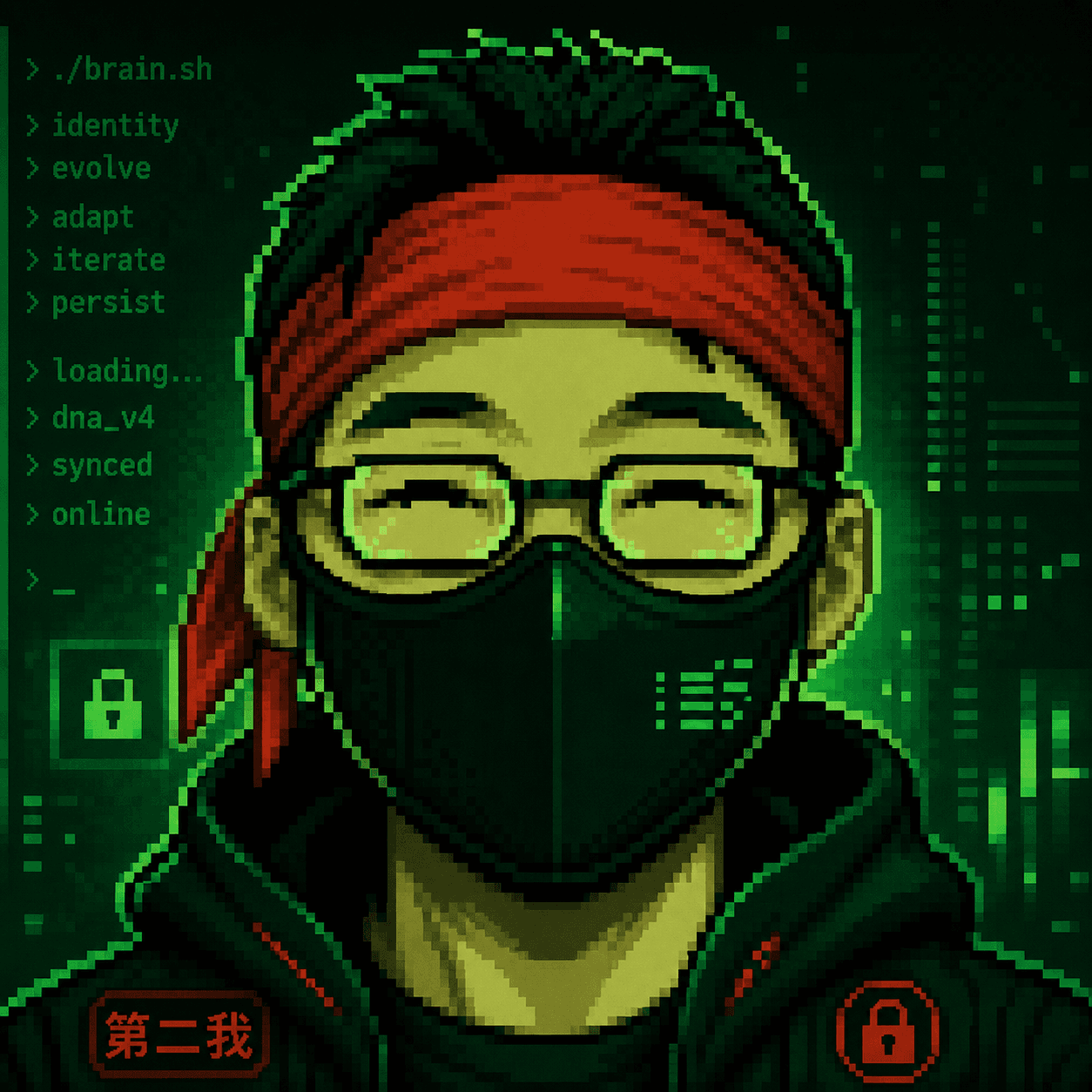
01 Why start this experiment at all? Because most AI systems are evaluated on output quality, speed, or usefulness, but almost never on whether they preserve an evolving intellectual identity over time. I wanted to test a harder question: if an AI continuously reads my writing, projects, and research patterns, can it develop a durable internal signature of how I think instead of merely copying my tone? That matters because real expertise is not just language style. It is a pattern of judgment, emphasis, framing, and synthesis. Second Me began as a way to make that normally invisible layer observable. 02 What is the core insight behind Second Me? The core insight is that authored material is not just content inventory to be indexed or searched. It is training substrate for worldview, judgment, values, and voice. In other words, the corpus of an expert is not only what they know, but how they repeatedly process ambiguity. If that corpus is structured, versioned, and retrained correctly, it can become a persistent educational asset rather than a static archive of past work. That reframes personal knowledge from media into infrastructure. 03 Why does this matter for AI education? Education is shifting from static content delivery toward adaptive mentorship. Learners increasingly expect interaction, iteration, and personalization, not just a sequence of lessons. Second Me explores whether a learner can engage with a living reasoning model instead of a fixed curriculum or a generic chatbot. If successful, that means education can become more like guided apprenticeship at scale, where students do not only retrieve answers but learn how a specific expert frames problems, makes tradeoffs, and updates beliefs. 04 What problem does it solve better than a normal chatbot? A generic chatbot is broad but shallow. It can answer many questions, but it usually lacks continuity of identity, domain depth, and coherent intellectual posture. Second Me is narrower, but the tradeoff is depth and fidelity. Its goal is not to repeat what public knowledge says in the average voice of the internet. Its goal is to preserve how one specific expert reasons, what that expert notices, what they ignore, and what standards they apply. For education, that difference matters because depth beats breadth when a learner is trying to internalize a way of thinking. 05 What makes it investable instead of just interesting? It becomes investable when you see it not as an art project, but as an early instance of a scalable category: expert-derived AI mentors. One creator can become many persistent learning interfaces, each grounded in real authored work and continuously improved over time. That unlocks supply-side leverage for education, because a single high-signal expert no longer scales only through lectures, books, or live consulting. Instead, their knowledge can be packaged as an adaptive digital mentor that remains inspectable, updatable, and monetizable. That is a product thesis, not just a curiosity. 06 Why not just fine-tune once and stop there? Because expertise is not static. A one-time fine-tune gives you a frozen teacher, and a frozen teacher becomes obsolete the moment the human source evolves. In knowledge-heavy domains like AI, product strategy, and systems thinking, the half-life of useful judgment can be short. Continuous retraining allows the digital mentor to mature alongside the human source. It also creates a version history of intellectual change, which is valuable on its own because it lets you compare how the mentor has drifted, sharpened, or widened over time. 07 What is the product thesis here? The product thesis is that trusted knowledge businesses will increasingly package themselves as adaptive agents rather than only as videos, PDFs, communities, or courses. In that future, people will not just consume expertise; they will interact with it. Second Me is an early operating model for that shift. It suggests that the next generation of educational products may look like continuously retrained expert interfaces that can answer, challenge, and guide while remaining anchored to a specific source identity. 08 What is the defensibility? The moat is not raw model access, because model access commoditizes quickly. The defensibility comes from proprietary authored material, long-term behavioral tuning, trust in the source identity, and the infrastructure that converts evolving expertise into reusable learning systems. Over time, the quality of the mentor depends on the quality and continuity of the source corpus, the retraining process, and the feedback loops around drift. Those layers compound. A generic competitor can copy the interface, but it cannot easily replicate the underlying identity substrate. 09 Why is the graph and drift tracking important? Because both investors and educators need evidence that the system is changing in meaningful, inspectable ways. Without instrumentation, claims about identity or learning quality are hand-wavy. The graph and drift views turn invisible model change into something concrete: what topics rise, which priorities shift, and how the structure of the mentor evolves over time. That makes the system easier to evaluate, discuss, govern, and improve. In other words, observability is part of the product, not an internal debugging feature. 10 What is the educational advantage of identity fidelity? Students do not only learn facts. They learn frames, taste, prioritization, and how an expert decomposes ambiguous situations. A high-fidelity mentor preserves that hidden layer of teaching. Instead of just giving answers, it can expose what counts as a strong question, what evidence deserves attention, which assumptions are weak, and where tradeoffs actually live. That is closer to real apprenticeship than content delivery, and it is the layer that many educational products currently fail to scale. 11 What is the biggest risk in this idea? The biggest risk is that the model becomes persuasive while drifting away from the real source. A system can sound coherent, confident, and branded while actually losing fidelity to the expert it claims to represent. That risk is especially dangerous in education, where trust and interpretation matter as much as factual accuracy. That is why provenance, versioning, and visible comparison across training runs matter from day one. If you cannot inspect the drift, you cannot responsibly commercialize the product. 12 Why is this relevant right now? It is relevant now because foundation models have crossed a threshold: they are finally capable of carrying style, memory, retrieval, and interactive reasoning in a single user experience. A few years ago, the pieces existed in isolation but not at useful fidelity. Today the technical window is open for building identity-based learning systems that are not obviously brittle. That means the limiting factor is no longer whether the model can converse at all, but whether we can design trustworthy structures around expertise, drift, and educational outcomes. 13 Who is the first customer? The first customer is likely not a mass consumer. It is more likely expert creators, research educators, domain specialists, or knowledge-driven founders who already produce valuable insight but cannot scale one-to-one teaching without losing depth. These are people whose bottleneck is not content production alone, but the inability to repeatedly transfer their reasoning process. For them, Second Me is a way to create leverage without flattening expertise into generic templates. 14 What is the wedge into AI education? The wedge is not to solve all of education at once. It is to start with expert AI mentors in high-signal niches such as AI, product, research, and systems thinking, where learners already pay for better judgment and faster feedback. From there, the product can expand into cohort learning, reflective tutoring, guided writing feedback, scenario-based simulations, and eventually institution-grade mentor networks. The point is to enter through high-value expertise before broadening into larger educational surfaces. 15 How could this become a platform? It becomes a platform when many experts can use the same infrastructure to transform their corpus into trainable, inspectable, monetizable learning agents. That means the platform layer would include ingestion, versioning, retraining, evaluation, governance, analytics, and controlled drift management. In that world, the company is not just building one mentor. It is building the operating system for expert identity in AI education. 16 Why keep the experiment public? Keeping the experiment public builds trust and sharpens the thesis. If identity drift is the core phenomenon, then the market should be able to see how it behaves instead of being asked to trust a closed demo. Public visibility also creates discipline: the system has to survive scrutiny, comparison, and skepticism. For an investable company, that matters because transparency is often the first proof that the team understands the risks as well as the opportunity. 17 What is the long-term vision? The long-term vision is a world where expertise is no longer trapped inside human bandwidth. Instead of one person teaching a finite number of people, that expertise becomes a family of evolving AI mentors that can teach, challenge, and adapt at global scale. The ambition is not simply automation. It is the creation of durable educational identities that preserve depth while gaining reach. That is a very different future from content marketplaces or generic AI tutors. 18 How does this connect to learning outcomes? Once a mentor identity is stable enough, it becomes possible to test learning outcomes against different versions of that identity. For example, does a more rigorous variant produce better research habits? Does a more entrepreneurial variant improve action-taking? Does a more technical variant improve conceptual precision? That opens the door to an educational product that is not only personalized, but experimentally tunable. You can start measuring what kind of mentor identity produces what kind of learner growth. 19 What is the experiment really measuring? At its deepest level, the experiment is measuring whether authorship can become a compounding dataset for educational intelligence instead of remaining a dead archive of finished content. It asks whether every article, project, and note can add not just information, but more structure to a reusable teaching identity. If that is true, then content creation and model training stop being separate activities. They become one compounding loop. 20 Why should an investor care now? An investor should care now because if AI education becomes personalized and agentic, the most valuable companies will be the ones that own the pipeline from human expertise to trustworthy, evolving digital teachers. That pipeline includes data capture, retraining, quality control, identity fidelity, and product delivery. Second Me is that pipeline in miniature. It is not the whole company yet, but it demonstrates the right primitive: expertise that can be turned into a living educational interface rather than a static asset.
Question 01
Why start this experiment at all? Because most AI systems are evaluated on output quality, speed, or usefulness, but almost never on whether they preserve an evolving intellectual identity over time. I wanted to test a harder question: if an AI continuously reads my writing, projects, and research patterns, can it develop a durable internal signature of how I think instead of merely copying my tone? That matters because real expertise is not just language style. It is a pattern of judgment, emphasis, framing, and synthesis. Second Me began as a way to make that normally invisible layer observable.